Spread betting vs CFDs: key differences
Spread bets and CFDs are both leveraged derivatives that let you
speculate on price movements without owning the underlying asset, but they
work differently, are taxed differently and suit different types of traders.


Key Takeaway
The main difference between spread betting and CFDs is tax treatment: spread betting profits are free from capital gains tax and stamp duty for most UK residents, while CFD profits are subject to CGT but CFD losses can be offset against other gains.
Spread betting and CFD trading are the two most popular ways to trade financial markets in the UK. Both are leveraged derivatives; they let you speculate on price movements across shares, indices, forex, commodities and more without owning the underlying asset. On the surface they look very similar. In practice, there are meaningful differences in how they work, what they cost, how they are taxed, and which traders they suit best.
This guide covers every key difference between the two products clearly and objectively, so you can decide which is right for you.
Spread betting vs CFD: at a glance
| Spread betting | CFDs | |
| How it works | Stake an amount per point of price movement | Trade contracts based on the difference in price from open to close |
| Availability | UK and Ireland only | Global |
| Capital gains tax | Exempt for most retail traders | Payable above £3,000 annual allowance |
| CGT rate (higher rate taxpayer) | N/A | 24% |
| Stamp duty | Exempt | Exempt |
| Loss offsetting | Cannot offset against other CGT gains | Can offset against other CGT gains |
| Commission on shares | No — charge included in spread | Yes — 0.10% per share, min £10 |
| Expiry | Fixed expiry date (can be rolled) | No expiry (except futures) |
| Currency denomination | GBP | Currency of underlying asset |
| Direct Market Access (DMA) | No | Yes (via CFD) |
| Negative balance protection (retail) | Yes | Yes |
How spread betting works
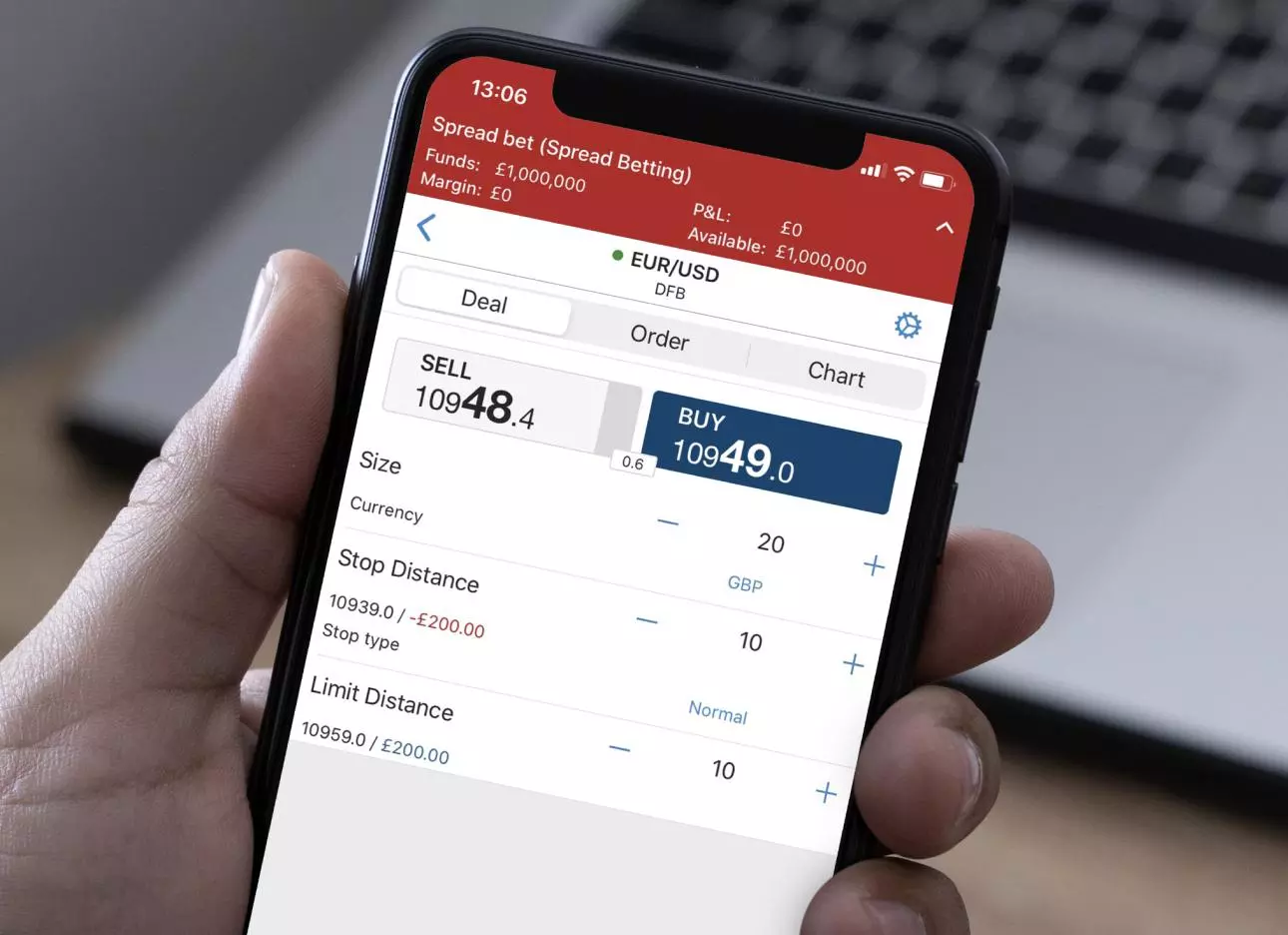
With spread betting, you stake an amount of money per point of price movement in the underlying asset. Your profit or loss is determined by how many points the market moves in your favour or against you, multiplied by your stake.
For example, if you go long on the FTSE 100 at £10 per point and the index rises 50 points, you profit £500. If it falls 50 points, you lose £500. All spread bets are denominated in sterling, regardless of the underlying market, which removes currency exposure from the equation.
Spread bets have a fixed expiry date. However, you can typically roll a spread bet forward to a later date if you want to keep the position open beyond the original expiry.
How CFD trading works
With a contract for difference (CFD), you agree to exchange the difference in the price of an asset from when you open the trade to when you close it. You trade a number of contracts — each contract represents a set amount of the underlying asset — and your profit or loss is based on the price movement multiplied by the number of contracts.
For example, if you buy 20 share CFDs in a company at 500p and the price rises to 520p, you profit 20 x 20p = £4 per contract. Share CFDs are charged a commission of 0.10% per side with a minimum of £10, rather than a spread. CFDs on indices, forex, and commodities are charged via the spread.
CFDs do not have a fixed expiry date and can be held indefinitely, with the exception of futures-based CFDs. This makes them more suitable for medium to longer-term positions. CFD accounts are also available globally while spread betting is a UK and Ireland-specific product..
The tax difference: the most important distinction
The single biggest practical difference between spread betting and CFDs for UK traders is tax treatment.
Spread betting profits are free from capital gains tax and stamp duty for most UK residents. HMRC classifies spread betting as gambling rather than investing. You do not declare spread betting profits on a self-assessment return. The trade-off is that you cannot use spread betting losses to offset other capital gains.
CFD trading profits are subject to capital gains tax above the annual £3,000 allowance. Current CGT rates on financial assets are 18% for basic rate taxpayers and 24% for higher and additional rate taxpayers, rates that increased from 10% and 20% respectively following the October 2024 Budget. CFD losses can be offset against other capital gains in the same year or carried forward, making CFDs useful for hedging strategies where tax efficiency on losses matters.
For a full breakdown of the tax rules, see our dedicated guides on how are spread bets and CFDs taxed and how is day trading taxed in the UK.
Costs: spread vs commission
For most markets, both spread betting and CFD trading are charged via the spread — the difference between the buy and sell price. With us, the spreads across the two products are essentially the same for most instruments.
The key exception is share trading. Share CFDs are charged a commission of 0.10% per side with a minimum of £10, rather than via a spread. Spread betting on shares incorporates the charge into a slightly wider spread instead, with no separate commission.
Both products incur overnight funding charges if you hold a cash (spot) position past 10pm UK time. This reflects the cost of leverage, effectively the interest on the capital required to hold the full-size position. Futures-based positions build the funding cost into a wider spread, so no additional overnight charge applies.
Leverage and margin
Both products use leverage. You put up a margin deposit (a fraction of the full position value) to gain exposure to the full trade size. For most major indices and forex pairs, margin requirements for retail clients are typically between 3.33% and 5% of the position value under FCA rules.
Leverage amplifies both gains and losses. On a spread bet or CFD with 5% margin, a 5% adverse move in the market wipes out your entire deposit. Under FCA rules, retail clients benefit from negative balance protection, meaning losses cannot exceed the funds in your account.
Direct Market Access
One advantage of CFDs that spread betting does not offer is direct market access. With DMA CFDs, we place a parallel trade in the underlying market when you open a position, meaning you trade at real exchange prices rather than our quoted price. This is particularly relevant for share trading, where DMA gives you access to the live order book and potentially better execution at high volumes.
Which should you choose?
Choose spread betting if:
- You are a UK or Ireland-based trader
- You generate consistent profits and want to retain them tax-free
- You trade indices, forex, or commodities primarily
- You want a simpler, GBP-denominated product
Choose CFDs if:
- You want to offset trading losses against other capital gains in your portfolio
- You want direct market access to share prices
- You trade from outside the UK or Ireland
- You want to hold positions indefinitely without expiry management
Many experienced UK traders hold both accounts and use each product where it is most appropriate — spread bets for speculative positions where they expect to profit, CFDs for hedging existing portfolio positions where the loss offset has tax value.
Spread bets and CFDs are complex instruments and come with a high risk of losing money rapidly due to leverage. 68% of retail investor accounts lose money when trading spread bets and CFDs with us. You should consider whether you understand how these products work and whether you can afford to take the high risk of losing your money. Under FCA rules, retail clients benefit from negative balance protection. Tax laws are subject to change and depend on individual circumstances.
Ready to get started? Open a spread betting account or open a CFD account with us today. Not ready to commit? Try a demo account with £10,000 in virtual funds.
Connect with us


Spread bets and CFDs are complex instruments and come with a high risk of losing money rapidly due to leverage. 68% of retail investor accounts lose money when trading spread bets and CFDs with this provider. You should consider whether you understand how spread bets and CFDs work and whether you can afford to take the high risk of losing your money.
Professional clients trading spread bets and CFDs can lose more than they deposit.
The value of shares, ETFs and other ETPs bought through a share dealing account, a stocks and shares ISA or a SIPP can fall as well as rise, which could mean getting back less than you originally put in. Past performance is no guarantee of future results. Some ETPs carry additional risks depending on how they’re structured, investors should ensure they familiarise themselves with the differences before investing.
Crypto - Don’t invest unless you’re prepared to lose all the money you invest. This is a high-risk investment, and you should not expect to be protected if something goes wrong. Take 2 mins to learn more.
Share dealing and IG Smart Portfolio accounts provided by IG Trading and Investments Ltd, CFD accounts are provided by IG Markets Ltd, spread betting provided by IG Index Ltd, cryptoassets services are provided by IG Digital Assets Ltd.
IG is a trading name of IG Trading and Investments Ltd (a company registered in England and Wales under number 11628764), IG Markets Ltd (a company registered in England and Wales under number 04008957) and IG Index Ltd (a company registered in England and Wales under number 01190902). Registered address at Cannon Bridge House, 25 Dowgate Hill, London EC4R 2YA. IG Markets Ltd (Register number 195355), IG Trading and Investments Ltd (Register Number 944492) and IG Index Ltd (Register number 114059) are authorised and regulated by the Financial Conduct Authority.
The information on this site isn’t directed at residents of the United States, Belgium or any particular country outside the UK and isn’t intended for distribution to, or use by, any person in any country or jurisdiction where such distribution or use would be contrary to local law or regulation.
